
For many students, academic success is measured through exams and assessments. International competitions offer a chance to apply knowledge, think under pressure and engage with peers from around the world.
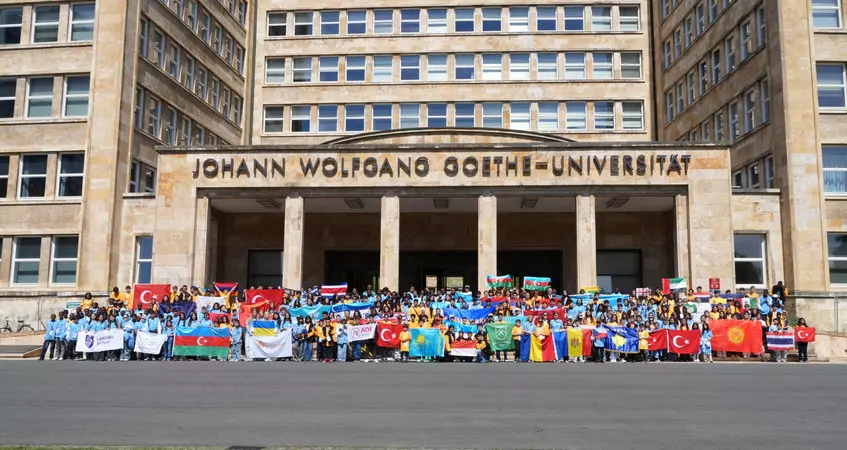
That experience was recently brought to life for students from The British School of Tashkent (BST), who travelled to Frankfurt to participate in the 2026 German Math Olympiad and Hi-Lingua Language Competitions, held between 28 April and 3 May.
That experience was recently brought to life for students from The British School of Tashkent (BST), who travelled to Frankfurt to participate in the 2026 German Math Olympiad and Hi-Lingua Language Competitions, held between 28 April and 3 May.
The events brought together 384 students from 47 countries, creating an environment in which academic achievement sat alongside cultural exchange and international collaboration. Representing Uzbekistan, BST students returned with an impressive collection of medals across mathematics and English-language disciplines.
Building confidence through challenge
Competitions such as the German Math Olympiad are designed to stretch students well beyond routine classroom learning. Rather than relying on memorisation, participants are challenged to think independently, solve unfamiliar problems and demonstrate analytical reasoning in demanding conditions.
BST students performed strongly, earning three Gold, one Silver and four Bronze medals, as well as two Honourable Mentions. One student also achieved a top-three placement in an international age category.
Experiences like these can play an important role in developing resilience and confidence, particularly for students who enjoy tackling complex problems and thinking creatively.
Communication skills on an international stage
Strong academic outcomes were also reflected in the school’s participation in the Hi-Lingua Language Competition, where students earned seven Gold, ten Silver and six Bronze medals, alongside three Honourable Mentions.
Unlike traditional language testing, Hi-Lingua places emphasis on communication in practice. Students participate in activities linked to debate, persuasive writing, public speaking and critical thinking, helping them build confidence in expressing ideas clearly and responding to different viewpoints.
For many families considering an international education, opportunities to strengthen communication and presentation skills are increasingly valuable preparation for university study and future careers.
Learning in an internationally minded environment
Founded in 2010, The British School of Tashkent offers a British international education for students from Early Years through to Sixth Form. Today, the school community includes nearly 600 students representing more than 40 nationalities, creating opportunities for students to learn alongside peers from diverse cultural backgrounds.
As part of Nord Anglia Education, BST students also benefit from access to a wider international learning network, including global collaborations, co-curricular opportunities and experiences that connect learning to real-world perspectives.
Participation in competitions such as those held in Frankfurt reflects a wider approach to education in which academic knowledge is paired with confidence, adaptability and the ability to engage internationally.
Looking ahead
In August 2026, BST is set to open a new campus designed to support students from Early Years to Sixth Form, with specialist learning spaces for science, technology, sport and performance.
For schools investing in international education, experiences beyond the classroom increasingly form part of a broader picture: helping students not only achieve academically, but also develop the confidence and skills to succeed in a global environment.


