Part of the Nord Anglia family, The British International School Abu Dhabi offers a transformational education in a warm, inclusive community, empowering every student to excel, embrace global opportunities, and shape their future.
Teaching Students How to Think in an Age of Artificial Intelligence
As artificial intelligence becomes increasingly woven into everyday life, schools are facing a fundamental challenge: how to prepare young people for a future in which information is abundant, answers are instant, and automation is advancing rapidly. At the heart of this challenge lies a crucial question, not what students will know, but how they will think.
At The British International School Abu Dhabi (BIS Abu Dhabi), developing high‑quality thinking is not seen as an add‑on to learning, but as its foundation. This belief has been strengthened through the school’s participation in a two‑year global research partnership with Boston College, led by Nord Anglia Education, exploring how students develop the cognitive and human skills that technology cannot replace.
From Research to Classroom Practice
Rather than approaching metacognition as a theoretical concept, the research focused on how thinking can be taught explicitly and consistently across different age groups, subjects and learning contexts. BIS Abu Dhabi was actively involved in this research, contributing classroom data, teacher reflections and student feedback over the two‑year period.
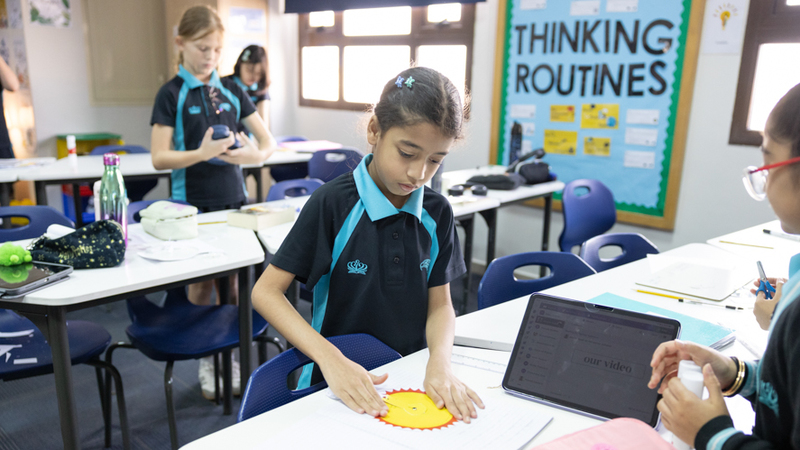
One of the clearest findings from the global study was the impact of thinking routines: short, simple strategies that help students make their thinking visible. When used regularly, these routines support learners in comparing ideas, considering alternative viewpoints, explaining reasoning and evaluating their own understanding.
The research demonstrated that students who experienced regular opportunities to reflect on how they learn showed significant growth in skills such as independence, creativity and critical thinking. These outcomes reinforce a growing body of evidence that students learn more effectively when teaching focuses not only on content, but also on learning processes.
Why Thinking Matters More in the Age of AI
AI tools can summarise texts, generate responses and solve routine problems in seconds. What they cannot do is evaluate meaning, judge relevance, adapt ethically or understand context in the way humans do. For students, this means that learning must go beyond producing answers and move towards questioning information, evaluating sources and making informed decisions.
BIS Abu Dhabi’s approach recognises that these capabilities do not develop automatically. Students need structured opportunities to practise slowing down their thinking, testing assumptions and learning from mistakes. This is particularly important as students increasingly encounter AI‑generated content in both academic and everyday settings.
By teaching students how to reflect on their own thinking, the school helps them become active participants in learning rather than passive recipients of information.
The use of Thinking Routines helps students make their thinking visible
What This Looks Like Day to Day
At BIS Abu Dhabi, the findings from the global research are embedded into daily teaching across the school:
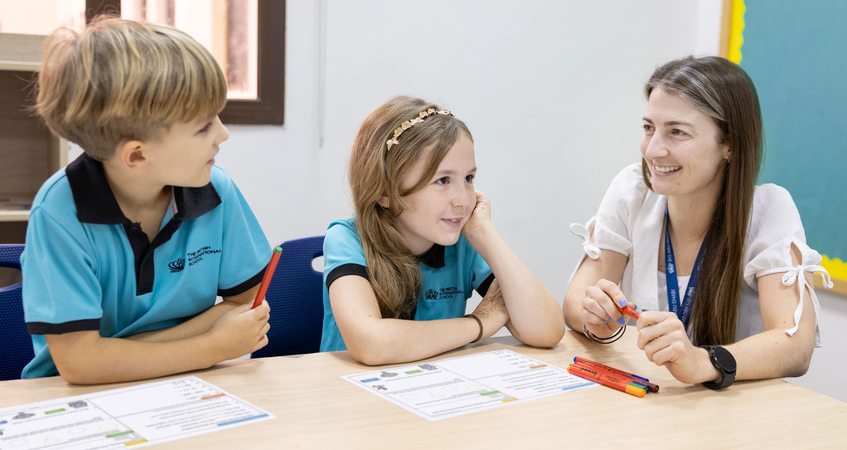
Younger students are encouraged to explain their ideas, compare outcomes and reflect on what they have learned, building early habits of curiosity and self‑awareness.
Primary learners regularly articulate how they solved a problem, what strategies they tried and what they might change next time.
Secondary students are supported to justify interpretations, evaluate different approaches and take increasing responsibility for their learning choices.
These practices are deliberately consistent across subjects, ensuring that students develop transferable thinking habits rather than isolated skills.
The Role of Teachers
A key insight from the research is that high‑quality thinking is strongly influenced by teaching expertise. At BIS Abu Dhabi, teachers are trained to model thinking explicitly, sharing their reasoning, asking purposeful questions and creating classroom environments where reflection is normal.
Rather than focusing solely on outcomes, teachers pay close attention to learning behaviours: how students respond to challenge, how they collaborate, and how they adapt when something does not work the first time. This professional practice ensures that thinking development is intentional, not incidental.
Preparing Learners for What Comes Next
The aim of BIS Abu Dhabi’s approach is not to prepare students for specific technologies that may change, but to equip them with durable human skills — reasoning, adaptability, judgement and independence — that will remain relevant regardless of future developments.
By aligning global research with everyday classroom practice, the school offers families confidence that learning is evidence‑informed, forward‑looking and deeply human. In a world shaped by AI, the ability to think well is no longer optional, it is essential. Enquire about joining BIS Abu Dhabi here.
More About The British International School Abu Dhabi
Part of the Nord Anglia family, The British International School Abu Dhabi offers a transformational education in a warm, inclusive community, empowering every student to excel, embrace global opportunities, and shape their future.