
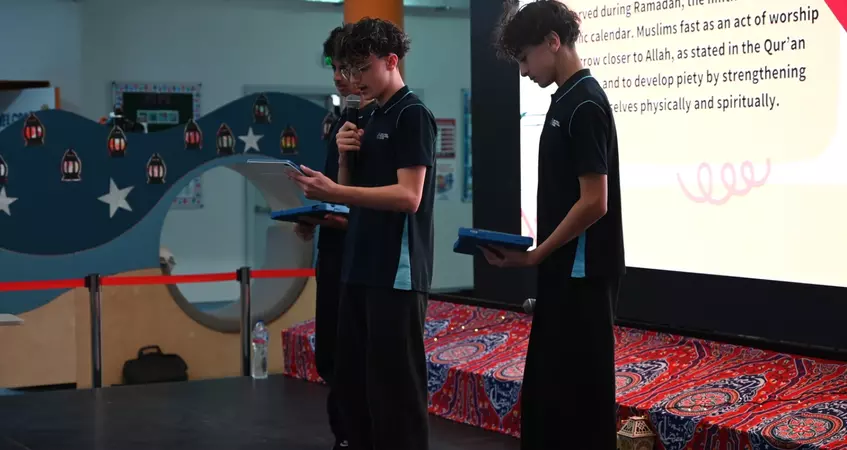
At One World International School (OWIS), Islamic Education is delivered within a comprehensive and integrated framework that embeds Islamic values, knowledge, and practice into every stage of the school's educational journey. It is based on an educational approach that balances Islamic knowledge, values development, and a deep understanding of the role of Islam in the life of the modern learner.
The curriculum is grounded in connecting Islamic teachings with students' daily lives and real-life experiences, helping them understand how these values influence behavior, decision-making, and social and ethical responsibility. Through this connection, Islam is presented as a comprehensive way of life rather than merely an academic subject, supporting students' personal development and enhancing their positive contribution to the global community. Core values such as respect for cultural diversity, tolerance, empathy, cooperation, and human solidarity are emphasized, supported by prophetic examples and Quranic narratives that reflect mercy, justice, and high moral conduct.
Assessment is an essential component of the learning process, using a variety of tools such as self-assessment, peer assessment, and continuous feedback, which enhance students' awareness of their progress and responsibility for their learning. Individual differences are carefully considered to ensure appropriate support and challenge for every learner. The teacher plays the role of a facilitator and role model, embodying Islamic values through daily behavior and interactions, making learning a holistic educational and character-building experience.
Islamic Education in the IB Primary Years Program (PYP)
In the IB PYP stage, Islamic Education focuses on building a strong foundational level of faith and values in a simplified, interactive, and age-appropriate manner. This stage is a key developmental phase in which core Islamic principles are introduced in an engaging way. Learning is based on experiential and activity-driven approaches, using storytelling, play-based learning, exploratory tasks, and simple classroom discussions to instill Islamic values in students' understanding and behavior. The primary focus is on developing Islamic identity and core moral values such as honesty, trustworthiness, mercy, respect, cooperation, and self-discipline.
Fundamental concepts such as the Six Pillars of Faith and the Five Pillars of Islam are introduced in a simplified and progressive way, with emphasis on practical understanding linked to daily behavior. Quran learning involves recitation and memorization of selected short Surahs appropriate to students' age, supported by simplified meanings to strengthen emotional connection and practical application.
Islamic Education in Middle and High School
In Middle and High School, Islamic Education becomes more advanced, analytical, and conceptually rich, focusing on developing critical thinking skills and connecting Islamic teachings to contemporary real-world issues. The curriculum expands into more detailed study of core Islamic disciplines, including Tawheed, Fiqh, Hadith and Seerah, Quran and Tafsir, and Islamic values and ethics. Students are encouraged to analyze concepts, understand their purposes, and apply them in diverse life contexts, enabling them to make informed and responsible decisions.
A deeper study of the Seerah of Prophet Muhammad ﷺ and selected Hadith is introduced, with emphasis on extracting leadership lessons, moral values, and educational insights from his life. These lessons are connected to modern-day challenges, helping students develop balanced moral and intellectual awareness. Teaching methods in this stage include structured discussions, presentations, project-based learning, research, and collaborative work, all of which promote academic independence, analytical thinking, and clear expression of ideas. Across all stages of learning, OWIS remains committed to developing learners who embody Islamic knowledge - in their character, their choices, and their contribution to the communities they are part of.
Written By,
Ibraheem Abu-Joudeh
Islamic Head


