
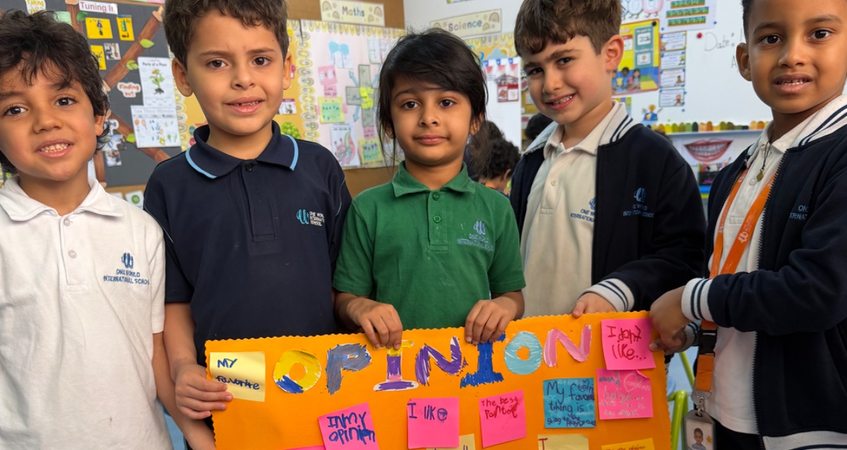
One World International School (OWIS) offers students from Pre-KG to Grade 5 an educational experience built on two complementary pillars: the American curriculum and the IB Primary Years Programme (PYP) framework. Understanding what that means in practice, and why the combination is intentional, is central to understanding what the school delivers.
The American curriculum defines what students learn. Anchored by Common Core State Standards and the Next Generation Science Standards (NGSS), it sets clear academic benchmarks across subjects - mathematics, literacy, science, and social studies, and is widely recognized by universities and educational institutions worldwide. Its emphasis on critical thinking, analytical reasoning, and adaptability makes it one of the most respected content frameworks in international education.
The IB PYP is not a separate curriculum. It is a transdisciplinary framework that determines how that content is taught and experienced. Designed for students aged 3 to 12, it is built on the principle that students are active agents in their own learning - curious, reflective, and aware of the world beyond the classroom. At its core are ten learner attributes, from being Inquirers and Thinkers to being Principled and Caring, which are woven into daily school life rather than treated as abstract ideals.
The learner attributes are not confined to a single subject or lesson. They inform how students approach a mathematics problem, how they engage in a group discussion, and how they respond to challenges and setbacks. Over the course of a student's primary years, these qualities become habitual - a natural part of how they think and engage rather than a layer added on top of academic learning. Together, the American curriculum and the IB PYP framework provide academic rigor and the habits of mind needed to apply it.
How it works in the Classroom
OWIS Riyadh implements this approach through the Kath Murdoch Inquiry Cycle - a structured, research-backed pedagogical model developed by one of the world's leading voices on inquiry-based learning, with over 15 published works on the subject. The cycle guides students through seven phases: Tuning In, Finding Out, Sorting, Going Further, Making Conclusions, Reflection and Assessment, and Action.
Each phase serves a specific purpose.
- Tuning In draws students into a topic through questions and prior knowledge rather than direct instruction, building investment in the learning from the outset
- Finding Out and Sorting develop the skills of gathering, evaluating, and organizing information which are habits that go well beyond any single subject area
- Going Further encourages students to extend their thinking independently
- Making Conclusions challenges them to synthesize what they have learned into informed perspectives
- Reflection and Assessment build self-awareness as learners
- Action closes the cycle with the expectation that learning has real-world relevance and consequence
This structure ensures that American curriculum content is not simply delivered and tested, but explored, contextualized, and applied. A lesson grounded in NGSS science standards becomes an opportunity for students to investigate, challenge assumptions, and connect their findings to real-world significance. Academic standards set the destination; the inquiry cycle determines how students get there.
The Outcome
Students at OWIS Riyadh leave primary school academically well-prepared, meeting benchmarks that support strong progression into secondary education and, in time, university pathways recognized globally. They are also equipped with something that academic content alone cannot build - the critical thinking, communication, and collaborative skills that allow them to perform in environments that demand more than the recall of information.
The school's approach reflects its broader mission: to develop inquiring, compassionate, and reflective learners who are prepared for the complexity and interconnectedness of the world they will inherit. At OWIS Riyadh, the curriculum and the framework are not two separate conversations. They are one coherent commitment to what education should achieve.
Learn More about OWIS - https://owis.org/sa/contact-us/


