
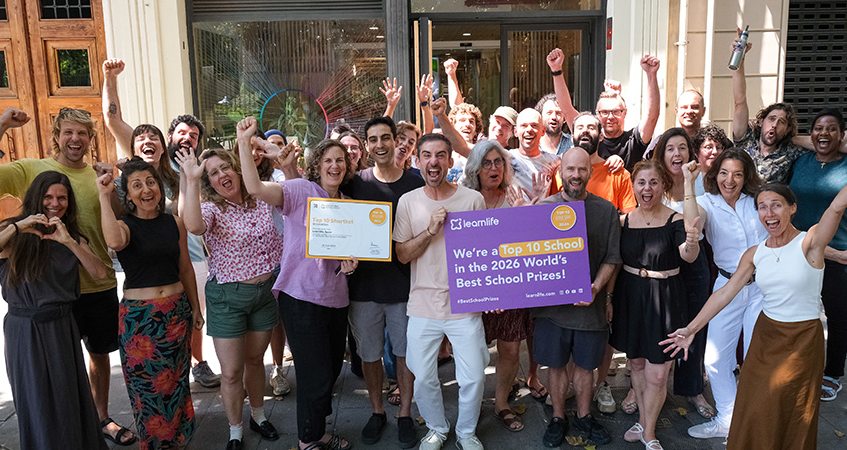
Learnlife has been shortlisted in the top 10 of the World’s Best School Prizes 2026, the only international school in Barcelona to be shortlisted and just one of 50 schools worldwide.
The prizes are run by T4 Education and are regarded as the world’s most prestigious education awards. Fifty schools were chosen across five categories drawn from thousands of entries worldwide. Learnlife earned its place in the Innovation category, recognition for the way it has rethought how a school can work.
What the judges saw
Learnlife was selected for creating a school built on trust, where children take charge of their learning and leave ready for life.
Most schools are built around control. Fixed timetables, standard tests, one route for everyone. Learnlife was built around a different idea. Since 2017, it has put trust at the centre and handed young people real ownership of how they learn and how they spend their day.
That principle shapes everything, from the way learners are assessed to the rhythm of their week. Leigh Fitzgerald, Learnlife’s CEO, describes it this way:
Most schools are built around control. Fixed timetables, standard tests, one route for everyone. Learnlife was built around a different idea. Since 2017, it has put trust at the centre and handed young people real ownership of how they learn and how they spend their day.
That principle shapes everything, from the way learners are assessed to the rhythm of their week. Leigh Fitzgerald, Learnlife’s CEO, describes it this way:
“Trust is often spoken about as a critical value in education, but very few schools are willing to build it into the core learning environment. In many schools, trust is treated simply as an aspiration or a slogan, but at Learnlife it’s a primary design principle that shapes how young people learn, grow, and prepare for life.”
For families used to a traditional setup, this is the part that takes a moment to absorb. Learners help design their own pathways through personal learning plans, guided by adults who genuinely know them. There are no exams in the usual sense. Some learners still choose to sit them, because they understand their goals and what a particular university or career asks of them. The choice belongs to the learner.
One visiting school leader put it plainly:
“Until I saw Learnlife’s graduating requirements, I did not believe examinations could be replaced with something of greater rigour.”
How learning is measured at Learnlife
Instead of grades, learners build a Learning Vitae. It’s a living portfolio of real work and honest reflection that grows over their time at the school. They share that growth through 360 presentations and community showcases, talking through what they’ve made and what they’ve learned along the way.
Learnlife graduate Storm is a good example of where this can lead. He arrived at Learnlife after struggling to find his feet in a traditional school. Given space to follow his interests, he found coding and 3D modelling. The portfolio he built earned him a scholarship to Harbour.Space University in Bangkok, and he now works as a Flight Dynamics Intern at Thailand’s national space agency and has created an app for scuba divers that funds coral restoration programmes.
He grew into that path by being trusted to lead his own learning. You can watch Storm's story here.
Learnlife graduate Storm is a good example of where this can lead. He arrived at Learnlife after struggling to find his feet in a traditional school. Given space to follow his interests, he found coding and 3D modelling. The portfolio he built earned him a scholarship to Harbour.Space University in Bangkok, and he now works as a Flight Dynamics Intern at Thailand’s national space agency and has created an app for scuba divers that funds coral restoration programmes.
He grew into that path by being trusted to lead his own learning. You can watch Storm's story here.
The evidence behind Learnlife’s approach
Recognition like this tends to follow results, and Learnlife has a few worth knowing about.
Graduation rates sit close to 100%. Learning Guide (teacher) retention runs at 96%, in a profession where many teachers leave within five years. HundrED, one of the most respected names in education research, has recognised Learnlife’s work three years running, and the international school received Montessori STAR endorsement in 2025 for its focus on child-centred learning,
An independent LEAPS Student Voice Survey this year placed Learnlife above global benchmarks across all seven measures assessed, with its strongest scores in agency, relevance and whole-child development. And in the 2025 graduating group, every single learner pointed to the relationships and sense of belonging at the school as central to their motivation.
The people supporting Learnlife know education from the inside. Valerie Hannon, a Board Director of the Innovation Unit and one of education’s leading thinkers, calls it “a truly wonderful school” that “shows what schools can be and do” and “at this time of learner disengagement and disillusion, societal polarisation and environmental crisis, the work of Learnlife could not be more essential.”
Lord Russell Rook, a member of the UK House of Lords, points to the relationships at its heart: “When teachers build real relationships, build trust with their students, it’s possible not only to change lives but to change communities and change the world. That’s what Learnlife is doing” And Haifa Khamis, Board Chair of Academia Cotopaxi in Ecuador, sums up why the approach matters: “When learners genuinely own their journeys, they become life-ready, not just exam-ready.”
Lord Russell Rook, a member of the UK House of Lords, points to the relationships at its heart: “When teachers build real relationships, build trust with their students, it’s possible not only to change lives but to change communities and change the world. That’s what Learnlife is doing” And Haifa Khamis, Board Chair of Academia Cotopaxi in Ecuador, sums up why the approach matters: “When learners genuinely own their journeys, they become life-ready, not just exam-ready.”
What this means for families considering Learnlife
A top 10 place among brilliant schools from across the world is an incredible achievement. It shows that Learnlife’s approach is working and making a real impact.
For a parent quietly wondering whether there’s a school where their child would feel known and genuinely want to learn, it’s a good moment to look more closely. Find out more and join an online info session at learnlife.com
For a parent quietly wondering whether there’s a school where their child would feel known and genuinely want to learn, it’s a good moment to look more closely. Find out more and join an online info session at learnlife.com


