For Brazilian families, the definition is changing. It's no longer just about exam results or a single university place — it's about building the confidence, curiosity and character to thrive anywhere in the world.
Ask any parent what they want for their child, and the answer is rarely just "good grades." Increasingly, families across Brazil are asking a bigger question: what kind of education will truly prepare my child for the years ahead?
It's a fair question. Technology is reshaping entire industries. Universities are more international than ever. Careers now cross borders in ways earlier generations could barely imagine. With that much change comes real opportunity — and a chance to rethink what "success" actually means.
"Families aren't simply asking which university their child might attend," says Maurice Hartnett, Head of School at The British College of Brazil. "They're asking how education can help their children thrive in a world where opportunities, careers and challenges increasingly cross borders."
Success is being redefined
For much of the last century, the formula was simple: study hard, pass your exams, get into a good university, build a stable career. That path still matters, a great deal.
But the world around it has changed. Academic excellence remains the foundation — no argument there. What's shifting is what that foundation needs to lead to. It's no longer enough for children to know things. They need to know how to use what they know: adapting, questioning and applying knowledge in situations no textbook could predict.
A shift Brazilian families are leading
For generations, a place at a leading Brazilian university was the goal for many families, and for many, it still is. But more parents are now asking a broader question: how can my child's education open doors, wherever those doors may lead?
That doesn't necessarily mean studying abroad. For some families, it might. For others, it means preparing children for careers in globally connected industries, or giving them the confidence to build something of their own. What ties these ambitions together isn't a desire to leave Brazil. It's a desire to make sure children are genuinely ready, wherever life takes them.
The skills that will matter most
If success is broader than exam results, what exactly should children be learning? Four capabilities stand out:
Critical thinking. Children today have more information at their fingertips than any generation before them. The real skill isn't finding information — it's questioning it, evaluating it and using it wisely.
Communication. Whatever path a child eventually chooses, the ability to express ideas clearly and work well with others will matter. Universities and employers alike value people who collaborate across cultures and perspectives.
Adaptability and resilience. The past few years have shown just how quickly the world can change. Children who learn to adapt, and bounce back from setbacks, build a skill that serves them for life.
Empathy and self-awareness. Understanding others, building relationships and navigating different social settings matter just as much as academic ability, for wellbeing as much as for long-term success.
As Hartnett puts it: "The most successful students will be those who combine strong academic foundations with curiosity, flexibility and a willingness to keep learning."
Why a global perspective matters more than ever
Universities are more international than ever, giving students access to more destinations, and more choice, than any generation before them. Programmes like the International Baccalaureate (IB) reflect this shift, built not around memorising facts but around inquiry, critical thinking and independent learning.
"The growing interest in international programmes reflects a broader desire from families to provide their children with an education that combines academic excellence with a global perspective," Hartnett explains. "Parents want their children to be prepared not only for university, but for the wider opportunities and responsibilities that come with participating in an interconnected world."
How BCB brings this to life
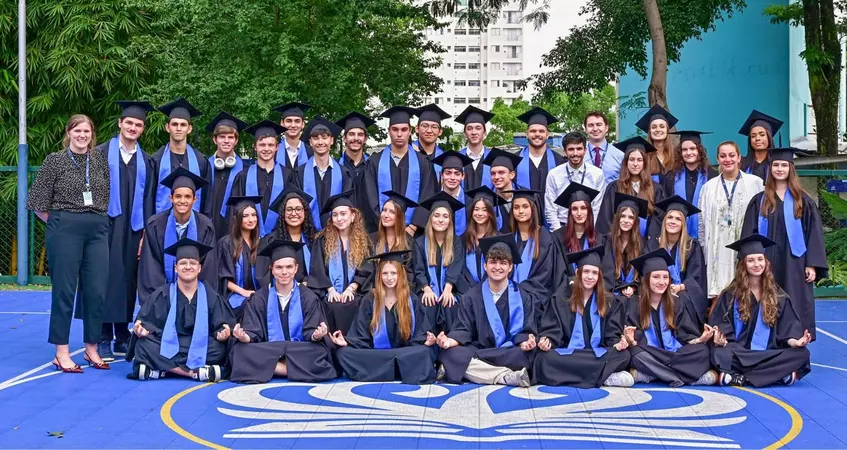
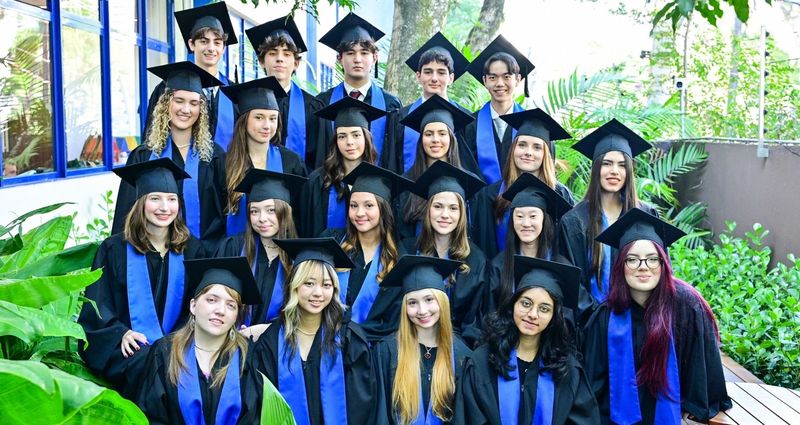
Class of 24-25
At The British College of Brazil, these ideas aren't theory. They shape daily life on campus.
Academic rigour still sits at the heart of what we do, with strong foundations in literacy, numeracy, science and the humanities. But every child's path looks different, which is why personalised learning sits alongside that rigour, tailoring support and challenge to each student.
That's easier when a school is genuinely, deeply diverse. At BCB, 50% of our students and 75% of our teachers are international, representing more than 38 nationalities. Every day, students learn alongside, and from, classmates and teachers with different backgrounds and perspectives. That's not just a statistic — it's part of what makes our community feel like a genuine family, not just a school.
As part of the Nord Anglia Education family, our students also gain access to learning experiences well beyond our own campus, including collaborations with MIT, Juilliard and UNICEF.
Beyond the classroom, students take part in service projects, leadership roles and collaborative initiatives that put learning into practice — because an education isn't just about acquiring knowledge. It's about learning to use it in ways that create value for others.
And it shows in where our graduates go next. In recent years, BCB students have gone on to study at University of Chicago, King’s College London, University of Edinburgh, UC Berkeley, FGV, Dartmouth College and São Leopoldo Mandic to name a few — proof that this kind of education keeps every door open, in Brazil and around the world.
Investing in tomorrow, today
None of us can predict exactly what the world will look like in ten or twenty years. What we can do is help children build the knowledge, character and perspective to navigate whatever comes their way.
"We cannot predict exactly what the world will look like ten or twenty years from now," says Hartnett. "What we can do is help students develop the knowledge, character and perspective that will allow them to navigate whatever awaits them. Ultimately, that's what families are investing in: not simply academic outcomes, but future possibilities."
That's the real definition of educational success today: not certainty about the road ahead, but the confidence to shape it.