
For students following the British curriculum, receiving GCSE results brings one stage of secondary education to an end – and quickly raises questions about the next.
Which subjects should I take at A Level? Is an academic or applied pathway the better fit? Which choices will keep university options open? And how much should future career plans influence decisions made at 16?
There is no single combination that works for every student. The strongest post-16 choices usually come from considering several factors together: academic strengths, genuine interest in a subject, preferred ways of learning and any requirements attached to future university courses.
This is particularly important because Sixth Form represents a significant change from GCSE study. Students typically move from a broad curriculum to a much smaller number of subjects studied in considerably greater depth.
Start with strengths – but don't rely on grades alone
GCSE results provide an important starting point. At Arbor School in Dubai, this year's Year 11 cohort achieved the school's strongest GCSE results to date. Across 283 I/GCSE entries, 60% of grades were awarded at 9-7 and 98% at 9-4 or equivalent, with almost one in four grades achieving the highest possible Grade 9.
Strong results can give students confidence about where their academic strengths lie, but the highest GCSE grade isn't necessarily the only reason to continue a subject. Students also need to consider whether they enjoy the type of thinking and work involved, particularly as A Level study becomes more specialised and independent.
For some students, the right pathway may also include an applied qualification. Arbor offers both A Level and BTEC options in Sixth Form, recognising that students have different strengths, ambitions and approaches to learning.
Think ahead to university – without deciding your entire future at 16
Few Year 11 students know exactly what career they want to pursue, and they don't need to. However, students who are considering particular university courses should understand whether there are subjects they will need to study at A Level.
Medicine and many science degrees, for example, have specific subject requirements, while other courses may offer considerably more flexibility. Researching these requirements early can prevent students inadvertently closing off an option they may later want to pursue.
For students who are less certain, choosing a combination that reflects their strongest interests and keeps several possible routes open can be a sensible approach.
This is where personalised guidance becomes particularly valuable. Through Arbor's Futures Programme, students begin exploring university and career pathways before reaching the point of application. Sixth Form students receive individual guidance to help them understand courses, entry requirements and destinations, while the Extended Project Qualification (EPQ) provides an opportunity to investigate an area of interest in greater depth.
The right pathway won't look the same for everyone
This year's Arbor GCSE cohort provides a good example.
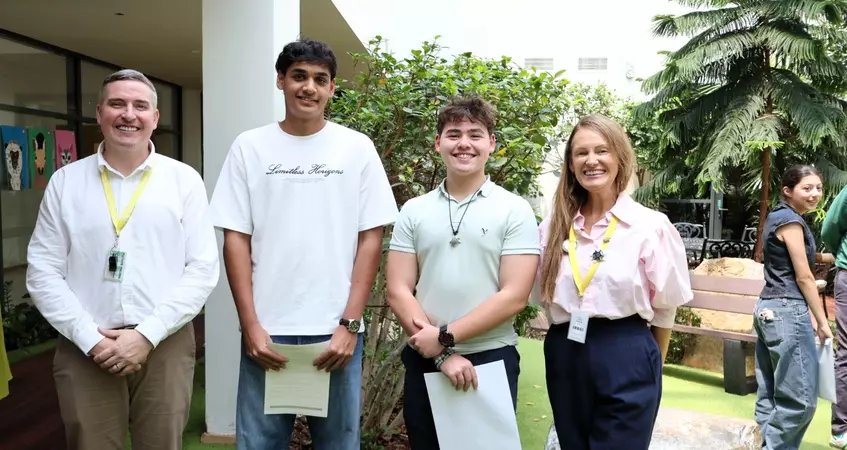
Ojas Jha achieved seven Grade 9s and two Grade 8s, having completed five of his GCSEs a year early. Rather than following a standard timetable simply because it is the conventional route, his next stage will continue to reflect his individual academic progress.
“I’m proud of what I’ve achieved at Arbor,” Ojas said. “I completed five of my GCSEs a year early, and the remaining four this year. I plan to make the same advanced progress in my A Levels at Arbor, aiming to finish some early.”
His experience illustrates a broader point: effective Sixth Form planning should respond to the student rather than expect every student to progress in exactly the same way.
For another student, the right decision might be a different combination of A Levels, an applied pathway or simply having more time and support to determine where their interests could lead.
Look at where the Sixth Form pathway leads
For parents choosing a secondary school, GCSE performance is useful information – but it is worth looking further ahead.
Questions to consider include what post-16 qualifications the school offers, how students choose their subjects, what university and careers guidance is available and, increasingly, what happens to students when they graduate.
Arbor has been able to answer that final question for the first time this year. Its inaugural graduating cohort completed their Sixth Form studies in 2026, with 48% of A Level entries awarded A*–A, 80% at A*–B and a 100% pass rate.
The cohort received more than 200 university offers across 16 countries and over AED 27.5 million in scholarship offers, before progressing to their next destinations.
For younger students, those outcomes help demonstrate the full journey that sits beyond GCSE Results Day.
GCSE results are a starting point
Results Day understandably focuses attention on grades. They represent years of work and deserve to be celebrated.
But once the envelopes have been opened and the celebrations are over, the most useful conversation may be a different one.
What does this student enjoy? Where are their strengths? How do they learn best? What possibilities do they want to keep open? And what combination of subjects and support will help them get there?
The answers will be different for every student. And that is precisely why choosing the next stage of education should be about more than simply choosing the subjects with the highest GCSE grades.


