
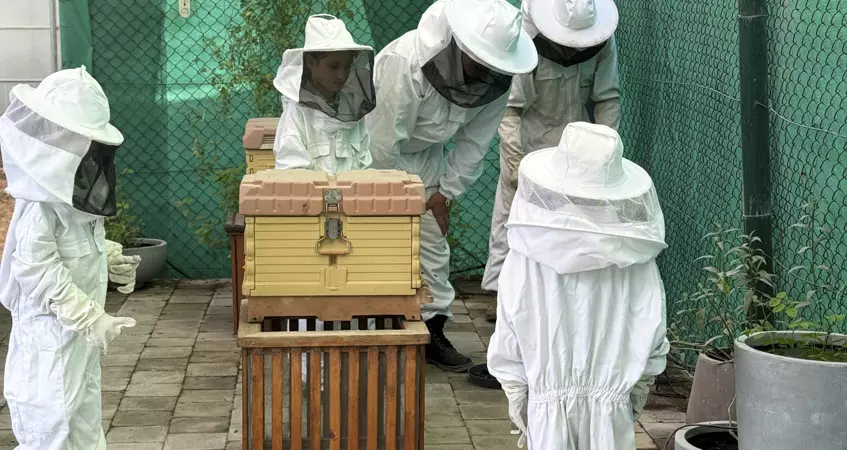
What can students learn from caring for a colony of bees? At Arbor School in Dubai, the answer reaches across science, mathematics and geography - and into questions about food, habitats and the decisions people make.
The school’s beekeeping curriculum has been shortlisted for Curriculum Initiative of the Year at the Tes Awards for International Schools 2026. Arbor is also a finalist for International School of the Year and the Sustainability Award.
For the British curriculum school in Al Furjan, the apiary offers a close-up view of relationships students explore in their lessons. Observing a colony helps them understand bee biology and behaviour. Looking beyond the hive, they investigate how pollinators depend on planting, habitat and climate, and how food production depends on healthy pollinator populations.
These experiences are planned alongside classroom teaching, with opportunities to revisit ideas and apply knowledge. Students learn to observe changes within a colony, handle equipment appropriately and understand the care a living system requires. Teachers assess both their understanding and their practical skills.
The apiary is one of several living classrooms at Arbor. Across the biodomes, BioPark and gardens, students can follow the connections between the species they study, the food they grow and the resources they use.
This learning forms part of the school’s Ecoliteracy curriculum, which develops from Foundation Stage through to Sixth Form. Younger children begin by spending time with nature, noticing changes and learning to care for living things. As students grow, they investigate more complex questions about environmental change and human responsibility.
The Sustainability Award shortlisting reflects how that learning extends into action. Students take part in mangrove propagation, marine conservation, biodiversity monitoring and Global Impact Projects. Within school, they also investigate environmental practices and propose improvements, contributing to decisions that affect their own community.
The International School of the Year nomination looks more broadly at how students learn and develop at Arbor. It considers academic outcomes alongside wellbeing, inclusion, staff development and opportunities in sport, the arts, leadership and service.
For families getting to know the school, the three nominations offer different perspectives on the same education: how children build knowledge, how they learn to use it and how they are supported along the way.
Arbor’s ethos, “Enough for all, forever”, connects these ambitions. Students are encouraged to pursue their own goals while considering what their choices mean for others and the world they share.
The shortlistings follow Arbor’s win of the World’s Best School Prize for Environmental Action in 2025. Winners of the Tes Awards for International Schools 2026 will be announced on 8 December 2026.


